Skip to content

Staff Transport Services

Recurring Employee Mobility Planning

Staff Transport Services for Offices, Teams, Projects and Workforce Movement Across the UAE

Staff transport services in Dubai and across the UAE help employers build repeatable, dependable employee movement rather than loose day-to-day travel arrangements. For HR teams, office administrators, facilities managers, operations leaders, hospitality operators, project coordinators, and business owners, the real value is not only the bus itself. The value is in creating a driver-included passenger transport system that protects attendance, punctuality, reporting discipline, route clarity, and the day-to-day stability of your workforce.

This page is designed for companies that want to compare fleet fit, route practicality, timing structure, service continuity, duty hours, pickup points, drop-off points, and commercial suitability before choosing a recurring staff transport arrangement. Whether the requirement is a single office route, a multi-stop employee commute, intercity workforce movement, or a monthly contract covering several pickup zones, this page helps explain how employers should judge the service properly before requesting a quote.

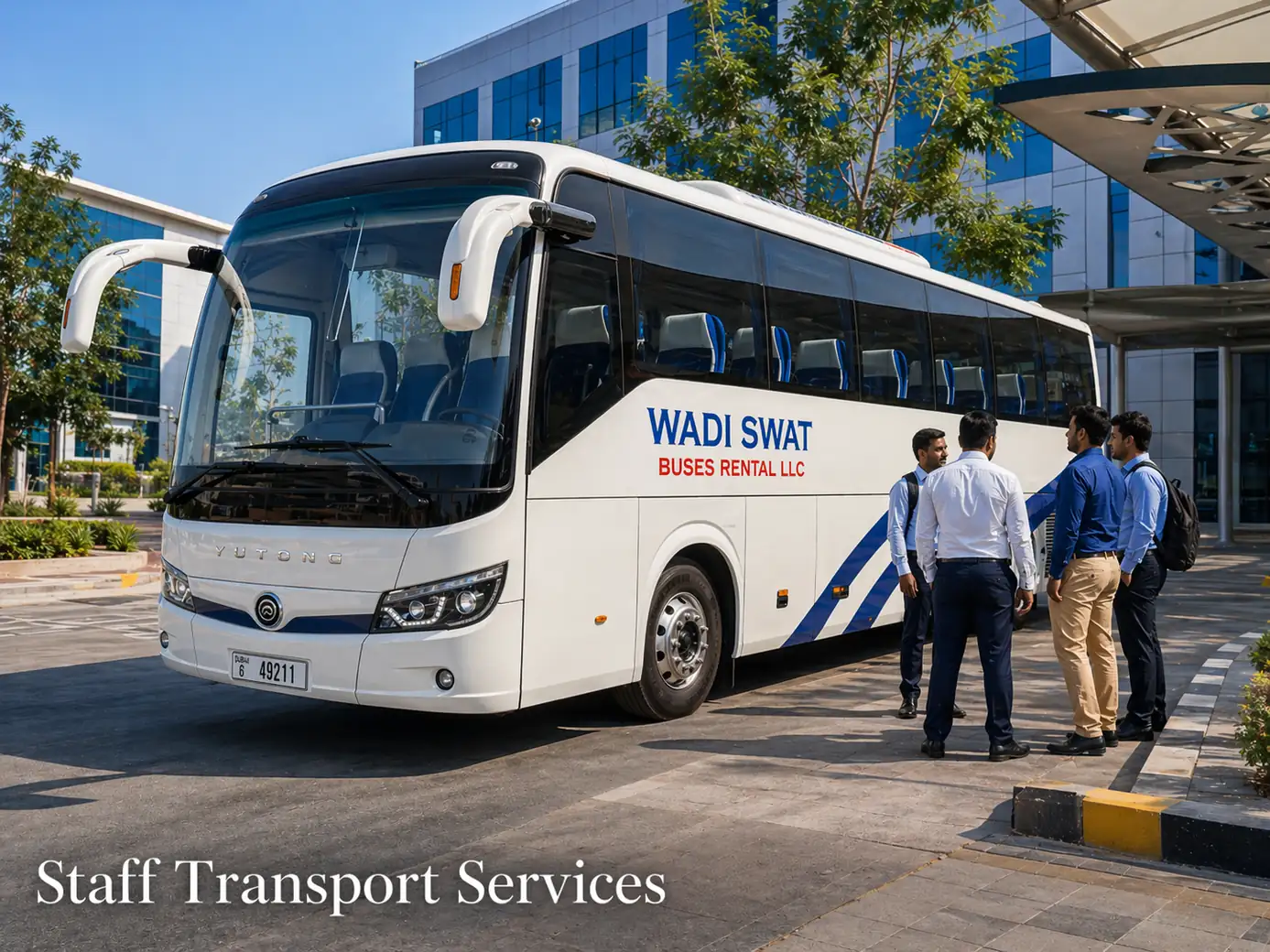
Staff transport services with dedicated company shuttle bus for recurring employee movement across the UAE
Recurring staff transport works best when the route is designed before the fleet is chosenTiming logic, pickup structure, service continuity, and fleet matching come before the final vehicle decision.
Staff Mobility Recurring Routes Contract-Ready Operations Office Timing Discipline Attendance Support UAE-Wide Employee Movement
Client TypeHR teams, admin managers, facilities leads, hospitality operators, project coordinators, and mixed-workforce employers
Booking ModelMonthly, quarterly, annual, and long-term recurring service agreements
Route TypeFixed-route, multi-stop, feeder, intercity, office commute, and shift-based employee movement
Best-Fit Range10 to 500+ passengers across one or multiple recurring staff transport routes
Service Overview

What Makes Staff Transport Services a Practical Business Solution

Staff transport services are most valuable when employee movement is too important to leave unmanaged. In many organisations, staff attendance directly affects production, office operations, client-facing standards, hospitality performance, project milestones, and internal service quality. When employees arrive late, when pickup coordination is weak, or when the chosen vehicle class does not actually fit the route, transport becomes a daily business problem instead of a support function.

That is why recurring employee movement should be judged as an operational system rather than a one-time trip. A strong staff transport arrangement brings together the route pattern, passenger count, reporting times, stop sequence, service frequency, and fleet allocation. When those elements are planned together, employers gain better attendance control, smoother reporting windows, and a more dependable service model over time. It also supports broader bus transportation services where the employer needs driver-backed movement, clear pickup and drop-off points, practical vehicle allocation, written quote scope, and a route plan that procurement, HR, admin, and operations teams can understand before approval.

This page therefore focuses on practical employer decision-making. It helps you review what staff transport is, when it becomes the right solution, how different route types should be assessed, what fleet sizes may suit different commuting patterns, and which commercial factors normally shape a recurring transport setup. Instead of generic transport claims, the goal here is to help employers think clearly about real service fit.

Service ValueStructured for recurring employee pickup and drop-off

Best for businesses that need a repeatable movement model, not improvised daily travel arrangements.

Operational FitPlanned around office reporting and shift timing

Route structure, arrival windows, and stop logic matter as much as vehicle size.

Common ConcernLate pickups, route inefficiency, and weak fleet matching

These are the issues employers usually want to prevent before the service starts.

Employer Decision Guide

Who Staff Transport Services Are Best Suited For and When Another Page May Fit Better

Best-Fit Buyer Profile

Who Usually Benefits Most from This Service

Staff transport services are ideal for employers that manage recurring employee movement and want a cleaner, more dependable transport structure. That includes corporate offices, business parks, free-zone employers, hotel and hospitality operators, call centres, back-office teams, facility management groups, mixed workforce operations, projects with recurring manpower movement, and companies running daily or shift-based staff travel. In these situations, the main goal is not simply moving people from one place to another. The goal is creating a system that protects punctuality and makes workforce movement easier to manage.

Employers with multiple pickup zones or a combination of office and field staff also often benefit from a dedicated page like this, because the route structure usually needs more thought than a simple vehicle booking. The buyer needs to understand how stop count, pickup order, travel distance, and passenger loads influence the service model.

Service Boundary

When This Service Page Is Too Broad or Too Narrow

Not every transport requirement belongs on the staff transport page. If the real need is a purely executive office loop, campus circulation, or a more corporate-facing internal shuttle, the stronger next step may be Corporate Shuttle Services. If the employer is still comparing broader employee-mobility models or wants a more solution-led page, Employee Transportation Solutions may be more suitable.

Similarly, if the main requirement is a long-term recurring arrangement where budgeting and service continuity are the primary concern, Monthly Contract Transport may provide the better commercial lens. For airport-only movement, VIP-only travel, or one-off guest trips, this page is generally too broad.

  • Use this page when recurring employee movement is the core requirement.
  • Use it when route discipline matters more than a one-time transport quote.
  • Use it when the company needs a practical contract-ready commute model.
  • Use a different page when the real need is executive shuttle, airport-only, or occasional private movement.
Planning Logic

The Route Logic Behind Strong Recurring Staff Movement

Route Design

Why Route Structure Comes First

In staff transport, the route is the service. Employers sometimes start by asking for a certain bus size, but the better question is how the route actually works. Where do employees gather? Are pickups concentrated or spread out? Is the route a single office commute or a multi-stop sequence? Is the movement inside one city or cross-emirate? Are there shift changes, split schedules, or multiple reporting windows? These details matter because they determine not only which vehicle class fits, but also whether the entire route will remain workable once it starts running daily.

Fixed pickup patterns, employee assembly points, residential cluster boarding, labour accommodation movement, office district staging, and hotel-staff collection all create different route dynamics. Some are simple and predictable. Others need stronger coordination, especially when traffic conditions, access windows, or multiple business locations are involved.

Scheduling Discipline

Timing Is Often the Real Success Factor

Recurring staff scheduling usually revolves around morning reporting, shift overlaps, early starts, staggered office times, late-evening returns, and changeover windows. The service works best when these timing realities are considered before dispatch plans are fixed. If the timing model is unrealistic, even a good fleet can still underperform because the daily operating rhythm never truly fits the workforce pattern.

Employers therefore need a staff transport arrangement that respects how their teams actually work. A hotel team will not move like a standard office. A business-park office commute will not behave like an industrial or project route. A well-designed page should make these route and timing realities visible so buyers can understand the planning logic clearly.

Operational takeaway

Recurring staff transport becomes easier to manage when the route brief is clear from the beginning: passenger volume, pickup pattern, reporting times, service days, peak traffic reality, return expectation, and the business context behind the movement. That route brief is the foundation for a workable transport decision.

Fleet Matching

How Fleet Suitability Should Be Judged for Staff Transport Services

Choosing a staff transport fleet is not about selecting the biggest or most visible vehicle. It is about matching the transport tool to the operational pattern. The right choice depends on passenger count, route distance, stop complexity, access conditions, shift timing, comfort expectation, and how often the route repeats. When the fleet suits the commute pattern, the service feels more stable. When the fleet is too small, too large, or simply mismatched to the route, the employer usually feels the problem quickly through delays, discomfort, poor boarding logic, or unnecessary cost.

That is why fleet decisions should always be made in context. A lighter office commute with modest passenger numbers may be well served by a smaller van. A mid-size employee route often works better with a minibus. Once the route becomes larger, more structured, or more demanding in terms of recurring passenger movement, a larger dedicated staff bus becomes more practical.

Recommended Vehicle

Toyota Hiace 12 Seater Passenger Van

This is often a strong fit for smaller staff routes, compact office teams, executive support staff, or lighter employee movement where access is tighter and the passenger group is more limited. It can also work well as a feeder option where a company uses multiple smaller pickup patterns rather than one large route.

Recommended Vehicle

Toyota Coaster 30 Seater Mini Bus

The Toyota Coaster is useful when the route needs more passenger capacity without moving into a full-size staff-bus format. It often suits medium-sized office commute patterns, hotel staffing support, or recurring employee movement where the passenger group is large enough to require a more structured vehicle.

Recommended Vehicle

Ashok Leyland 50+ Seater Staff Transport Bus

Once the route grows in volume or involves larger workforce movement, bigger staff buses become more practical. They are well suited where employee numbers are high, the route repeats daily, and the employer needs a more formal capacity structure to support operational continuity.

Cost and Commercial Factors

The Main Cost Drivers in Staff Transport Services

Employers usually want an accurate quote, but recurring staff transport pricing becomes most useful when the route and service basis are already defined properly. A reliable commercial comparison should not be built on vague assumptions. It should be based on the actual commute pattern, because that is what determines how the service will be operated day after day.

Vehicle size is only one element in the pricing model. Route distance, service hours, number of pickups, waiting expectations, stop complexity, frequency, timing pressure, intercity travel, and the duration of the service agreement all influence the final quotation. In practical terms, a well-structured route can often deliver better long-term value than a loosely defined route even if the headline vehicle category looks similar.

Quote FactorWhy It MattersWhat Employers Should Prepare
Commute distance and running hoursLonger distances and longer operating windows usually increase driver time, route commitment, and fleet planning complexity.Provide pickup zones, drop-off location, expected start time, and approximate return timing.
Passenger volume and fleet sizeThe number of employees moving on each run directly affects the vehicle class and sometimes the number of vehicles needed.Share realistic daily passenger counts instead of rough estimates where possible.
Stop complexity and timing pressureMultiple pickups and high-pressure reporting windows make route discipline more important and can affect route structure.List the main stops, the priority pickup order, and whether reporting times are fixed or flexible.
Frequency and service periodDaily, weekly, monthly, quarterly, and annual arrangements do not behave the same commercially.Explain whether the service is one-time, pilot-stage, monthly, or long-term recurring.
City or cross-emirate movementIntercity commuting introduces additional travel time, traffic exposure, and operational planning considerations.Clarify whether the route is within one city or runs between emirates such as Dubai, Sharjah, Ajman, or Abu Dhabi.

When employers share this information properly, the quotation becomes clearer and more commercially useful. It also reduces the risk of comparing several prices that are based on different assumptions. Good decision-making starts with a good service brief.

Business Use Cases

Best-Fit Staff Transport Use Cases Across Offices, Hotels, Projects and Mixed Workforces

Office MovementRecurring employee pickup and drop-off

Ideal where attendance and reporting stability matter for back-office teams, business parks, and administrative departments.

Hospitality TeamsHotel and service-staff transport

Useful for early starts, split shifts, and daily team movement where timing windows are critical to hotel operations.

Project TeamsStructured workforce commuting

Suitable where projects require dependable movement to and from work locations without daily coordination pressure.

Multi-Site EmployersIntercity and multi-stop staff routes

Strong fit for employers whose teams travel between accommodation, offices, facilities, and different operating zones.

UAE Route Reality

Staff Transport Services in the Real UAE Operating Environment

Across the UAE, recurring staff movement is affected by traffic pressure, business-district access, pickup staging constraints, residential cluster coordination, industrial or project-site timing, and the need to keep arrivals consistent despite route variation. Dubai, Abu Dhabi, Sharjah, Ajman, and other operating areas all create different staff-transport conditions. Some routes are shorter but more congested. Others are longer but more straightforward. Some need early-morning discipline. Others revolve around split-shift return movement.

This is why employers often prefer a provider that understands staff transport as a route-planning responsibility, not only as a vehicle supply category. Service value increases when the transport model reflects UAE operating reality from the start.

Employer Priorities

What Employers Usually Want to Reduce

Most employers are trying to reduce the same types of risk: delayed reporting, inconsistent daily movement, difficulty in scaling routes, unclear communication, and paying for a setup that does not truly match the workforce pattern. A stronger staff transport page should help employers see how those problems can be reduced through clearer planning.

  • Reduce late arrivals and reporting disruptions.
  • Reduce route confusion and stop-order inefficiency.
  • Reduce fleet mismatch and avoid over- or under-sizing.
  • Reduce daily administrative effort once the service begins.
Plan-Based Upgrade

Route Brief, Fleet Fit and Quote Scope Before Approval

The content plan for this page requires the buyer to understand service fit, fleet fit, route and timing details, pricing factors, trust proof, and a clear quote path. For staff transport services, the strongest improvement is to make the approval process practical: define the passenger count, pickup point, drop-off point, duty hours, waiting expectation, vehicle direction, and service frequency before comparing offers.

This is especially important for staff transport services in Dubai because the same passenger count can behave differently in Business Bay, Jebel Ali, Dubai South, Deira, Sharjah, Ajman, or Abu Dhabi. A route that looks simple on paper may need a different vehicle or timing buffer once access gates, tower entrances, accommodation pickup, traffic pressure, and shift reporting windows are reviewed.

Route BriefPickup and drop-off points first

Use exact gates, lobbies, towers, accommodations, staff assembly points, and office entrances rather than broad area names.

Fleet AllocationVehicle size follows the route

Passenger count, luggage, access width, stop order, comfort expectation, and route duration should decide the fleet direction.

Timing ControlDuty hours and waiting matter

Morning reporting, shift changes, standby time, split returns, and late-night movement should be clear before approval.

Quote ScopeCompare the same service basis

A fair quote should show route, vehicle class, service days, pickup sequence, return scope, waiting time, and contact responsibility.

  • Confirm passenger count by route, shift, and daily movement pattern.
  • Confirm whether the service is local, intercity, monthly, quarterly, annual, or project-based.
  • Confirm if the vehicle waits, returns later, or completes only one pickup and drop-off run.
  • Confirm the final quote path through request, contact, pricing, fleet, and trust-support pages.
Booking Process

How to Plan and Request Staff Transport Services Properly

Step-by-Step Process

The Cleanest Way to Request a Quote

The easiest way to get a useful staff transport quote is to provide the information that actually drives the service. Share the number of employees, route or pickup pattern, destination, reporting time, return time, service days, vehicle preference if known, and whether the requirement is one-time, monthly, or long term. The clearer the brief, the more accurate the route review and vehicle recommendation can be.

Once those details are available, the route can be assessed, the suitable vehicle class can be matched, and the booking structure can be reviewed with more confidence. This is especially important for recurring staff routes because an unclear start almost always creates unnecessary revision later.

Why This Matters

Accuracy at the Start Makes the Whole Service Easier

Recurring staff movement becomes easier to manage when the employer and provider start from the same transport picture. If only a keyword is shared, the quote may remain too generic. If the route pattern, timing pressure, staff count, and operating rhythm are shared, the resulting recommendation is usually much stronger.

This also helps internal decision-makers. HR, admin, procurement, and operations teams can review a clearer proposal, compare it more fairly, and move toward approval with less guesswork.

FAQs and Trust Standards

Frequently Asked Questions About Staff Transport Services

These are the questions employers commonly ask when reviewing recurring staff transport and comparing which service structure fits their requirement best.

What is the best way to plan staff transport services for a company?

The best way is to start with a proper route brief, not only a vehicle request. A useful brief should include the number of employees, pickup points, destination, reporting time, return time, service days, duty-hour expectation, and whether the route is one-time, monthly, or long term. Once the route pattern is clear, the vehicle class, driver timing, stop order, and quote basis can be reviewed with far less guesswork.

Do you provide staff transport services in Dubai and across the UAE?

Yes. Staff transport services can be planned for Dubai, Abu Dhabi, Sharjah, Ajman, and wider UAE movement when the pickup locations, destination, passenger count, and timing requirements are clear. The same service can support office teams, hotel staff, project employees, free-zone workers, industrial staff, and mixed workforce routes, but each route should be assessed according to access, distance, timing pressure, and daily repetition.

Which vehicle types are commonly used for staff transport services?

Common staff transport options include passenger vans for smaller teams, 17-seat and 20-seat route options for compact employee movement, Toyota Coaster-style minibuses for mid-size groups, and larger staff buses for high-volume recurring routes. The correct vehicle should not be selected by seat count alone. It should also match pickup access, passenger comfort, route distance, stop complexity, luggage or work items, and the number of daily trips required.

What details are needed for an accurate staff transport quote?

A strong quote normally needs the exact pickup points, destination, staff count, reporting time, return time, service frequency, number of stops, preferred vehicle type, and whether the vehicle must wait or operate as a repeated route. For company approvals, it also helps to share the contract duration, billing requirement, purchase-order process, and the contact person who will coordinate the route on working days.

Is staff transport suitable for monthly and long-term contracts?

Yes. Staff transport is especially suitable for monthly, quarterly, annual, and long-term recurring arrangements because the service can be structured around stable reporting times and repeated route movement. Long-term planning makes it easier to match the right vehicle, define driver duty hours, control route expectations, and keep the commercial scope clear for HR, admin, procurement, and operations teams.

How do I choose between a smaller van, minibus, and large staff bus?

Start with the number of passengers, but do not stop there. A smaller van may work better for compact teams, tight community access, executive support staff, or feeder routes. A minibus is often better for medium groups with regular office or hotel movement. A larger staff bus usually makes sense when the route carries a bigger workforce, repeats daily, and needs a stronger capacity structure. The final choice should follow passenger count, stop order, route distance, access space, and timing pressure.

Can staff transport include multiple pickup and drop-off points?

Yes, multiple pickup and drop-off points can be planned, but they should be shared in the correct order before pricing is finalized. Each extra stop affects travel time, route reliability, driver duty, and sometimes the vehicle size. For multi-stop employee movement, the best approach is to group nearby pickup points, avoid unnecessary detours, define one final reporting deadline, and keep one coordinator responsible for route communication.

How are staff transport prices usually calculated?

Pricing is usually shaped by vehicle size, route distance, number of trips, driver duty hours, service days, pickup complexity, waiting time, return scope, and contract duration. A low headline price may not be useful if it excludes waiting time, extra stops, late returns, or route changes. The fairest comparison is to ask every provider to quote the same route details, service frequency, vehicle class, and timing scope.

What is the difference between staff transport and corporate shuttle services?

Staff transport is the broader employee-movement service for offices, hotels, projects, industrial teams, and mixed workforce routes. Corporate shuttle services are usually more specific to office loops, business parks, campus-style movement, executive staff circulation, or fixed internal company shuttles. If the main need is general recurring employee pickup and drop-off, staff transport is usually the stronger page. If the need is a polished office-loop or campus shuttle, the corporate shuttle page may fit better.

Can staff transport support shift-based employee movement?

Yes. Shift-based transport can be planned when the start times, changeover windows, return timing, and employee groups are clearly defined. This is important for hotels, facilities teams, security teams, industrial operations, project sites, and businesses with early morning or late evening staff movement. Shift routes need careful timing because delays can affect attendance, handover, service quality, and operational continuity.

Can the same staff transport route run between different emirates?

Inter-emirate staff transport can be reviewed when the pickup city, destination city, travel window, passenger count, and frequency are clear. Routes between Dubai, Sharjah, Ajman, Abu Dhabi, and other emirates need extra attention to traffic buffers, driver timing, daily distance, and return arrangements. For cross-emirate commuting, the route should be checked as an operating plan, not only as a bus rental request.

What should employers confirm before approving a staff transport booking?

Before approval, employers should confirm the exact pickup points, destination, stop order, passenger count, reporting time, return time, service days, vehicle type, quote inclusions, waiting rules, extra-stop policy, and one responsible coordinator. Written confirmation protects both sides and reduces disputes about route changes, delays, additional trips, or different expectations after the service starts.

How can staff transport improve attendance and daily workforce stability?

A planned staff transport service reduces reliance on individual travel decisions and gives the employer a more predictable reporting system. When pickup points, route timing, and return movement are organized, employees have a clearer travel routine and managers can better control arrival windows. This is especially useful where late arrivals affect production, hotel operations, office coverage, shift handovers, or project-site readiness.

Do staff transport services work for hotels, projects, and industrial locations?

Yes. Staff transport can support hotel teams, project staff, facilities teams, factory workers, free-zone employees, warehouse teams, and industrial-location movement when the route is properly planned. These routes often need stronger attention to shift timing, access gates, accommodation pickup points, site entry rules, and return arrangements. The best vehicle and price depend on the actual operating pattern, not only the industry name.

What is the safest way to choose the right staff transport provider?

The safest approach is to judge the provider by route understanding, fleet suitability, communication clarity, quote transparency, and ability to support recurring service expectations. A provider should ask about pickup points, timing, passenger count, frequency, and route conditions before recommending a vehicle. This helps avoid under-sized vehicles, unclear pricing, weak timing plans, and daily coordination problems after the route begins.

Final CTA

Need Help Planning Staff Transport Services?

Send your staff count, pickup pattern, reporting times, service days, destination, and any route notes so the most suitable recurring transport structure, fleet mix, and commercial setup can be reviewed properly. Whether you are planning a single office route or a larger workforce arrangement, a clear service brief will help move the discussion toward a more useful quotation.

Emailmukhtar@swattransport.ae
Phone+971 54 388 6682
CoverageDubai, Abu Dhabi, Sharjah, Ajman and wider UAE staff transport demand zones