Area Coverage and Route Guide
JAFZA
Jafza requires route planning around free-zone businesses, port logistics, warehouses, offices and shift-based employee routes. The practical choice is not made from seat count alone; pickup access, reporting time, stop pattern, luggage, duty length and the final destination must be reviewed together.
Share the pickup and destination pins, timetable, passenger count, luggage and access instructions so the route, vehicle class and commercial scope can be reviewed practically and in writing.
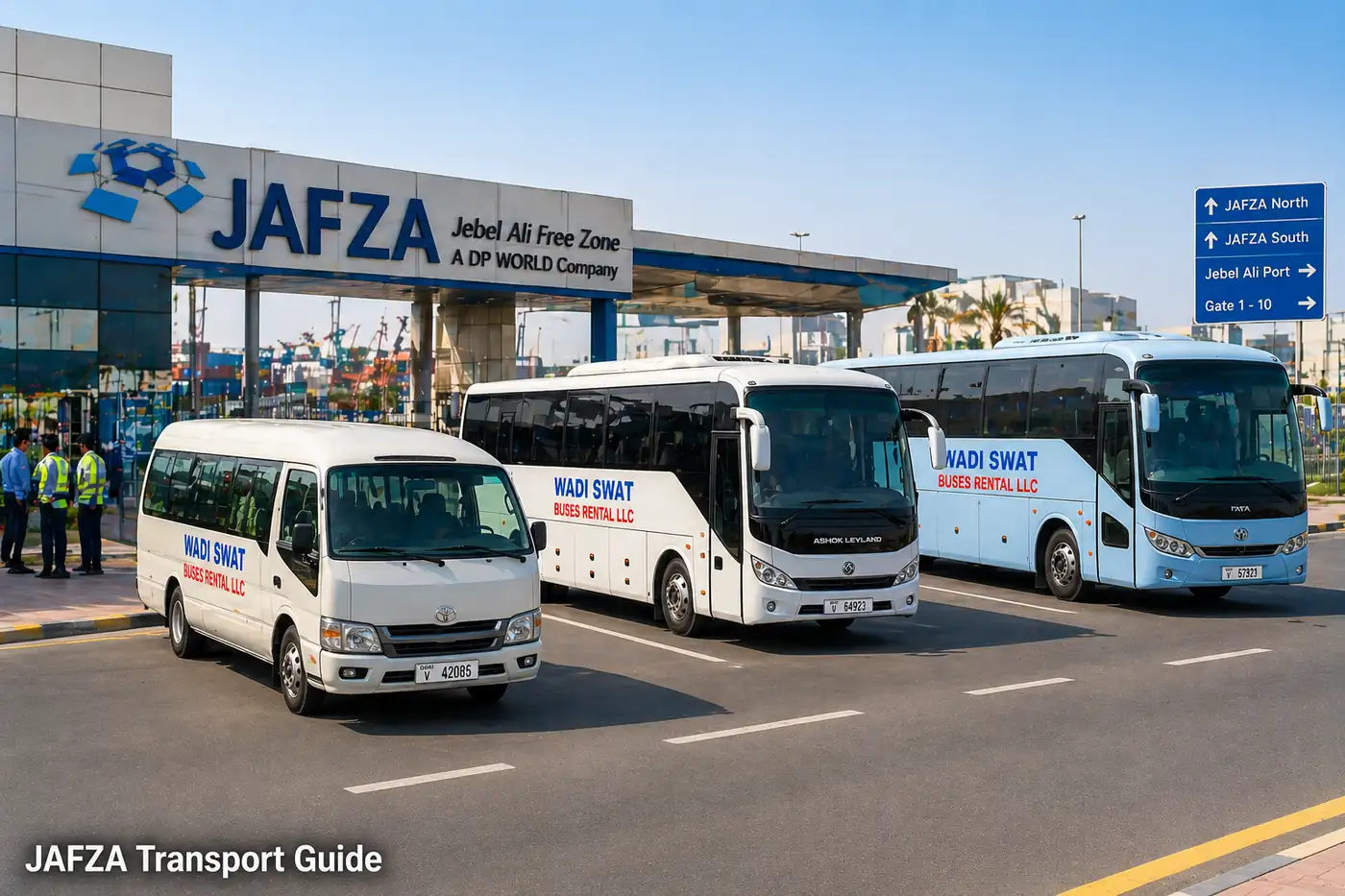
Jafza
Planning Step 1
JAFZA Transport Area Guide: Coverage and Service Area
The coverage scope should be defined from actual pins and practical access across free-zone businesses, port logistics, warehouses, offices and shift-based employee routes. Nearby districts can be included only after the complete route and operating window are checked.
Districts, Zones and Nearby Locations — Jafza
The coverage scope should be defined from actual pins and practical access across free-zone businesses, port logistics, warehouses, offices and shift-based employee routes. Nearby districts can be included only after the complete route and operating window are checked.
Geographic scope — Jafza
Confirm the pickup boundary, destination boundary, road access, building or gate name and whether the vehicle can wait safely without obstructing traffic.
Pickup, Destination and Route Examples — Jafza
Common movements include employee reporting, contract transport, hotel or visitor transfers, school or institutional groups, events and private-group travel. Industrial and free-zone duties often depend on gate passes, shift changes, camp-to-site timing, security procedures and safe waiting areas. A route that works outside peak hours may need a different pickup sequence during shift handovers.
Typical movement — Jafza
List every stop in sequence, identify the final reporting time and separate passenger loading time from the actual driving time.
Planning Step 2
Transport Services Available — Jafza
Industrial and free-zone duties often depend on gate passes, shift changes, camp-to-site timing, security procedures and safe waiting areas. A route that works outside peak hours may need a different pickup sequence during shift handovers.
Staff, Labour and Contract Routes — Jafza
Typical users include factories, warehouses, contractors, logistics teams, facility operators and companies arranging daily employee or workforce transport. Recurring services should be built around the operating calendar, shift pattern, passenger distribution and a stable communication process.
Recurring duties — Jafza
For daily or monthly duties, confirm operating days, reporting and return windows, pickup sequence, authorised route changes and the escalation contact.
Airport, Event, Hotel and Private Groups — Jafza
One-time services may include airport, hotel, event, meeting, leisure or private-group movement depending on the area. The schedule should include realistic loading, waiting and return assumptions.
One-time services — Jafza
For a single trip, provide the date, reporting time, passenger count, luggage, stops, return plan and any venue or terminal instruction.
Planning Step 3
Vehicle Options for the Area — Jafza
Industrial and free-zone duties often depend on gate passes, shift changes, camp-to-site timing, security procedures and safe waiting areas. A route that works outside peak hours may need a different pickup sequence during shift handovers.
Vans and Minibuses — Jafza
Vans and minibuses can suit smaller or medium groups where access is tighter, stops are frequent or the route does not justify a full-size bus. The usable capacity must include luggage and comfort needs.
Smaller groups — Jafza
Choose the vehicle only after confirming passengers, luggage, access height, road width, parking and the required service standard.
Buses and Coaches — Jafza
Larger buses and coaches are more practical for high-volume staff, workforce, school, event or tourism movement when the route permits safe access and staging.
Larger groups — Jafza
For larger groups, review loading time, seat requirement, luggage bay, driver duty, permits, backup planning and the space available at both ends.
Planning Step 4
Access, Traffic and Commercial Factors — Jafza
Industrial and free-zone duties often depend on gate passes, shift changes, camp-to-site timing, security procedures and safe waiting areas. A route that works outside peak hours may need a different pickup sequence during shift handovers.
Parking, Gates, Tolls and Permits — Jafza
Industrial and free-zone duties often depend on gate passes, shift changes, camp-to-site timing, security procedures and safe waiting areas. A route that works outside peak hours may need a different pickup sequence during shift handovers. Gates, parking controls, tolls, access permits and security checks should be treated as operating inputs, not last-minute details.
Area constraints — Jafza
Share any permit process, registration requirement, loading restriction, no-waiting rule, height barrier or security checkpoint before final confirmation.
Duty Hours, Distance and Waiting — Jafza
The quotation should reflect the real distance, duty hours, waiting, stop count, tolls, parking, route frequency and service period rather than a headline distance alone.
Quotation factors — Jafza
Written commercial scope should state the route, timings, vehicle class, inclusions, exclusions, waiting treatment, change process and validity period.
Planning Step 5
Book Transport in This Area — Jafza
Jafza requires route planning around free-zone businesses, port logistics, warehouses, offices and shift-based employee routes. The practical choice is not made from seat count alone; pickup access, reporting time, stop pattern, luggage, duty length and the final destination must be reviewed together.
Map Pins and Schedule Information — Jafza
Jafza requires route planning around free-zone businesses, port logistics, warehouses, offices and shift-based employee routes. The practical choice is not made from seat count alone; pickup access, reporting time, stop pattern, luggage, duty length and the final destination must be reviewed together. A complete enquiry allows the operations team to review route feasibility and give a more accurate written scope without unnecessary revisions.
Required enquiry details — Jafza
Send the service date, operating days, map pins, passenger count, luggage, timings, stops, contact person and any site, hotel, airport or event instructions.
Availability and Route Confirmation — Jafza
Availability is confirmed only after the required vehicle, driver, route and timing have been checked for Jafza. Recurring duties may also need a route trial or operational review.
Next steps — Jafza
The next step is written confirmation of availability, vehicle class, route, schedule, commercial terms and the agreed process for changes or support.
Controlled Related Links
Continue to the Approved Related Service and Route Pages
These links are part of the approved internal-link plan and lead to the most relevant route, vehicle, service or policy pages.
Frequently Asked Questions
Questions About Jafza
Practical answers covering route scope, access, vehicle choice, commercial factors and confirmation steps.
Coverage for Jafza is confirmed from the exact pickup and destination pins, operating date, timetable, passenger count and access conditions. Nearby or connected routes can be reviewed, but availability remains route- and date-dependent.
For Jafza, provide map pins, building or gate names, parking or staging instructions, security requirements and a contact person at each end. These details help prevent delays and unsuitable stopping points.
Vehicle choice for Jafza depends on the usable passenger count, luggage, stop pattern, route distance, road and height access, comfort requirement and whether the duty is one-time or recurring.
Travel time and price for Jafza can be affected by distance, traffic, number of stops, waiting, duty hours, tolls, parking, permits, access delays and any backup-vehicle requirement.
The route for Jafza is confirmed after the map pins, schedule, passenger requirements and access notes are reviewed. The final scope, vehicle class, inclusions and commercial terms should then be issued in writing.
Next Step
Request a Transport Route Review for Jafza
Send the complete movement brief for an operational review and a written quotation covering the route, vehicle class, timing and inclusions.
Exact map pinsPassenger countTiming and stopsLuggage and access