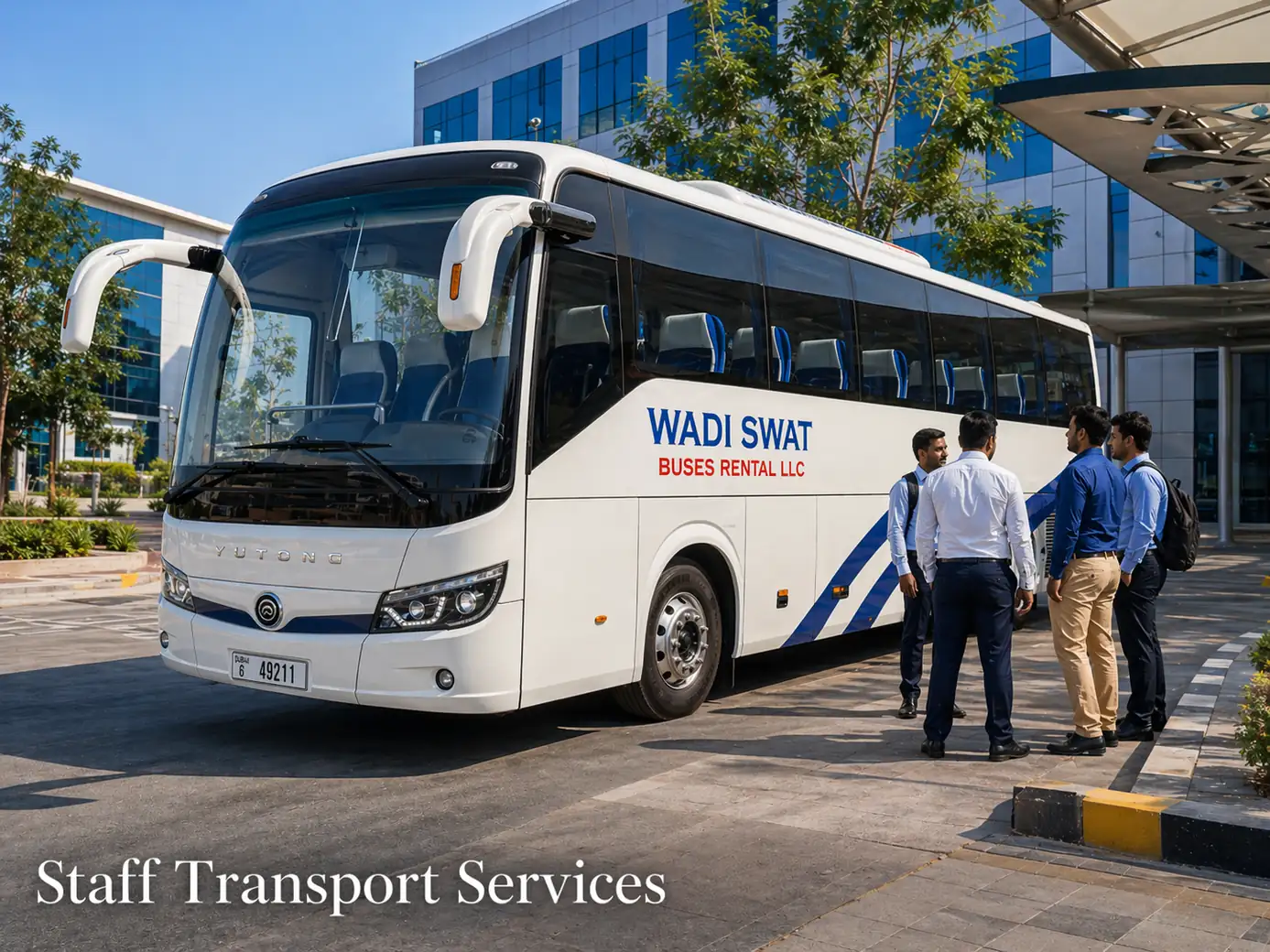
Staff Transport Services
Staff Transport Services for Offices, Teams and Workforce Movement Across the UAE
Staff transport services work best when the employer is not forced to guess. The real requirement is usually bigger than simply asking for a bus. Companies need dependable employee movement, practical route planning, punctual reporting support, and a fleet setup that can continue working every day without creating attendance pressure or admin fatigue. This page is designed to help decision-makers judge those points before committing to a recurring arrangement.
Wadi Swat Buses Rental LLC supports businesses that need a structured employee transport solution across Dubai, Abu Dhabi, Sharjah, Ajman, and wider UAE demand zones. Whether the requirement involves office commuters, hospitality teams, mixed workforce movement, free-zone staff shuttles, intercity employee travel, or multi-stop pickup and drop patterns, the right service model is built around route discipline, timing control, and operational fit. That is the core theme of this page.
What Staff Transport Services Really Mean for an Employer
Many employers first search for staff transport services because they know a commuting issue already exists. Employees may be arriving late, route arrangements may be inconsistent, current transport may be too small or too scattered, or internal teams may be spending too much time fixing daily movement problems. In those situations, the real objective is not simply to hire a bus. The real objective is to create a staff movement system that works repeatedly, communicates clearly, and reduces disruption rather than adding more of it.
That is why a strong staff transport service page must go beyond catalogue language. Employers do not need a generic description that says buses are available. They need help understanding how recurring employee transport behaves in practice. A good setup is shaped by employee count, pickup geography, office or site reporting time, return timing, route length, traffic pressure, shift overlap, passenger comfort expectations, and the level of consistency required week after week. The more clearly these factors are understood in advance, the smoother the service becomes after launch.
For many businesses, staff transport also has a management value that is easy to underestimate. Reliable employee movement supports attendance, improves punctuality, reduces daily commute uncertainty, and helps operations managers maintain control across departments. For hospitality teams it affects service readiness. For offices it affects start-of-day productivity. For mixed workforce sites it affects shift continuity. For project and support teams it affects how smoothly the operating day begins. This is why recurring staff movement deserves a proper planning process rather than a last-minute vehicle-only discussion.
Why Staff Transport Services Are a Practical Choice Across the UAE
Across the UAE, staff transport remains one of the most practical service models for employers who need employees to arrive together, on time, and with less commuting uncertainty. The country’s business geography creates repeated movement needs between residential clusters, labour accommodation, business districts, free zones, hospitality sites, industrial areas, education zones, airports, and support facilities. Public movement options may not align with shift timing, shared informal transport may be inconsistent, and daily reimbursement models can become costly or difficult to supervise. That is where a structured staff transport solution becomes commercially useful.
In Dubai, employers often deal with early office starts, long cross-city commutes, dense traffic corridors, and multiple pickup communities. In Abu Dhabi, route distances and inter-district movement can affect both timing and comfort. In Sharjah and Ajman, many employers rely on cross-emirate commuting patterns that need careful dispatch timing to stay dependable. In Jebel Ali, DIP, business parks, hotel clusters, logistics-facing districts, and free-zone environments, employee movement may involve mixed route logic rather than a simple one-stop journey. A provider that understands these realities can help the client choose a more suitable staff transport structure from the start.
What makes the service valuable
The commercial value of staff transport services is not limited to the vehicle itself. The bigger value is the reduction of daily friction. A dependable route makes attendance more predictable, reduces repeated employee transport complaints, helps supervisors plan more confidently, and gives the organisation a clearer operating rhythm. That can be especially important when the workforce is spread across several areas or when the employer is responsible for multiple shifts, different departments, or service windows that cannot tolerate inconsistent arrivals.
- Improves daily punctuality and attendance support
- Creates a clearer recurring commute structure for employees
- Reduces admin time spent solving daily transport problems
- Supports growth by making routes easier to scale and manage
- Provides a more professional staff movement system for the employer
Who Staff Transport Services Are Best Suited For
Corporate Offices & Admin Teams
Corporate employers often need employee transport that supports fixed office reporting times, business-district access, and a more organised commuting system for staff members who live across multiple residential clusters. Office staff transport must balance punctuality, route simplicity, and an employee experience that feels stable enough for long-term use.
Hospitality & Service Operators
Hotels, service companies, and customer-facing businesses often rely on staff transport because team readiness affects guest experience and service performance. Shift-based operations, early starts, evening returns, and employee dispersal across different accommodation areas all make structured transport especially useful.
Mixed Workforce & Multi-Site Employers
Where companies manage office personnel, support teams, operational staff, and site-linked employees at the same time, staff transport helps create a predictable commute model across multiple routes. That is especially important when employees are spread across several pickup areas or when route timing directly affects operational continuity.
The page is also relevant for facilities managers, procurement leads, group movement planners, school and institution administrators where recurring staff travel is required, and business owners who want to review employee transportation more carefully before requesting a quote. It is less suitable where the actual requirement is only a one-time airport transfer, VIP-only chauffeured movement, or a very small occasional family booking. In those cases, a more targeted service page such as Corporate Shuttle Services, Employee Transportation Solutions, or another specific service page may provide a cleaner fit.
Recurring Staff Transport Is Won or Lost in the Route Design
The most common mistake in employee transport planning is starting with the bus and not the route. Employers often begin by asking how many seats are available, but the more important questions are about where employees are located, how many pickups are needed, how tightly the reporting time is set, what buffer is required for traffic, and whether the return trip is simple, staggered, or shift-based. Once those questions are answered, the correct vehicle category becomes much easier to identify.
Strong route planning considers pickup density, cluster logic, stop count, likely delays, route sequencing, assembly-point practicality, and building access. A route with too many scattered pickups may look efficient on paper but fail in real traffic. A route that ignores stop discipline may create daily attendance problems. A route that starts too late may leave no margin for morning congestion. This is why recurring staff transport benefits from a realistic design stage, even if the employer’s goal is only to request a quote initially.
Different movement models create different route designs. Some employers need a fixed daily pattern that rarely changes. Some need split routes based on departments or shift timings. Some need cross-emirate employee movement where one route cannot reasonably serve every passenger. Some need feeder movement from residential areas into a main office, project site, business park, or hotel cluster. The right solution is almost always the one that reflects how employees actually travel, not how the schedule looks in a simplified spreadsheet.
Pickup and staging considerations
- Use clear assembly points where possible instead of unpredictable roadside pickups
- Confirm whether employee residences are clustered or widely dispersed
- Allow realistic time buffers for high-traffic corridors and long routes
- Review office, hotel, factory, site, or tower access windows before finalising dispatch
- Separate routes when service quality drops due to excessive stop count
- Think in terms of repeatability: if the route works only one day, it is not yet a route model
For employers, this means the first staff transport discussion should include employee pickup areas, office or site location, first reporting time, last return timing, approximate passenger distribution, and any access limitations at the destination. The more transparent the route brief, the more accurate the service recommendation becomes.
How Timing Discipline Affects Staff Attendance, Morale, and Daily Performance
Staff transport is often requested because employee attendance is becoming harder to protect through informal commuting arrangements. If reporting times are important, the timing model must be treated as a serious part of the service, not as a last-minute assumption. The employer needs to think about first-in time, acceptable arrival buffer, shift handover, return movement, meal break impact where relevant, late-evening travel, and the difference between normal traffic and peak traffic conditions. When those timing questions are left unresolved, even a good vehicle can become part of a poor service experience.
Punctuality matters for more than just appearance. In customer-facing businesses, a late team affects service readiness. In offices, repeated late arrivals damage internal coordination. In support or operational teams, delayed arrivals can push work into backlog or disrupt shift handovers. In larger organisations, transport delays can create frustration for supervisors who are measured on performance but cannot control the route directly. A well-run staff transport arrangement reduces that pressure by creating an agreed daily rhythm that everyone understands.
Good timing discipline also improves the employee experience. When employees know where to be, when to be there, and what to expect from the service, daily uncertainty decreases. That does not mean every route can avoid all traffic. It means the route is planned realistically, communicated properly, and managed with the level of care that recurring use requires. Employers should look for that mindset when comparing providers, because reliable timing is one of the strongest signs that the staff transport setup has been built professionally.
Choose the Vehicle Around the Route, the Passenger Count, and the Long-Term Use Case
Vehicle suitability plays a major role in staff transport services, but it should always follow the route brief. A smaller passenger van may be the right solution when the employee count is modest, the route is relatively simple, and the pickup pattern is compact. A minibus can be a stronger option when the route carries a medium-sized team or requires a bit more room and flexibility. Full-size staff buses become increasingly practical when passenger volume is higher, the route is recurring, and the employer wants a more consolidated commute system rather than multiple smaller vehicles running in parallel.
Wadi Swat’s wider fleet relevance for staff movement includes practical categories such as the Toyota Hiace 12 Seater Passenger Van for smaller employee groups, the Toyota Coaster 30 Seater Mini Bus for medium-range recurring transport, and larger staff bus formats such as the Ashok Leyland 50 Seater Staff Transport Bus or higher-capacity variants where the route requires broader coverage. The real decision depends on passenger distribution, route complexity, comfort requirement, and whether the employer wants to scale the route gradually over time.
Employers should resist the temptation to over-specify or under-specify the fleet based only on budget or appearance. Too small a vehicle can make the route inefficient or uncomfortable. Too large a vehicle can reduce flexibility or create unnecessary cost if the pickup pattern is not designed properly. The strongest fleet decision is the one that reflects passenger volume, route practicality, service period, and the consistency expected from the arrangement over the coming weeks or months.
What Usually Shapes the Cost of Staff Transport Services
Employers often want to understand staff transport pricing early, which is reasonable, but the most accurate quote depends on how clearly the recurring movement pattern has been defined. In most cases, cost is influenced by route length, daily running hours, number of trips, number of stops, pickup spread, passenger count, vehicle class, waiting time, return timing, and whether the service is one route or a network of multiple linked routes. The more structured the operation becomes, the more important it is to quote against the real requirement instead of an oversimplified assumption.
Contract period also matters. A monthly arrangement may be priced differently from a short recurring trial. A long-term route with consistent usage offers a different planning profile from a variable route that changes frequently. Intercity staff movement may introduce wider operating considerations than a compact same-city office route. Early morning starts, late-night returns, split shifts, and special access conditions can all influence the commercial structure as well.
The most helpful approach for a buyer is to prepare a clean brief: approximate staff count, pickup locations or pickup clusters, destination, timing, trip frequency, preferred service start date, and whether the movement is one-way, return, or shift-based. This makes the quote more meaningful and avoids the frustration that comes from comparing prices that were based on incomplete assumptions.
Key quote factors employers should prepare
- How many employees need transport on each route
- Where the pickups begin and how widely the team is distributed
- The reporting time at office, site, hotel, or business location
- Whether the route is one-way, return, split-shift, or staggered
- Vehicle preference, if already known, and any comfort expectations
- How often the service runs: daily, six days a week, weekly, or monthly
- Any building access, parking, waiting, or operational constraints
If you want to compare rate behaviour more closely, you can also review our Bus Rental Rates page after reading this service page. That page can complement the service explanation here by giving additional pricing context.
How the Staff Transport Booking and Onboarding Process Usually Works
The best staff transport onboarding process is clear, disciplined, and easy for the employer to manage. The goal is not just to issue a quote; it is to shape a route model that can be operated with confidence once the service begins. When the requirement is recurring, the extra attention paid at the planning stage usually saves far more time later.
Begin with employee count, pickup areas, destination, reporting time, return timing, and whether the service is recurring or one-time. If shift structure is relevant, include that from the start.
Assess whether the route should run as one line, multiple lines, feeder movement, or a different structure based on stop count, traffic exposure, and passenger spread.
Choose the most suitable vehicle category according to passenger volume, route complexity, comfort need, and the level of recurring use expected over time.
Once the operating structure is clear, the employer can review the quotation, service period, route plan, and practical next steps for implementation.
For a larger employer, this process may also involve route segmentation, phased rollout, or internal approval before final confirmation. That is normal. A provider who understands staff transport will support that practical review instead of treating it as unnecessary delay. Because recurring employee movement affects daily operations, sensible evaluation is a strength, not a weakness.
How Staff Transport Services Differ from Related Transport Pages
One reason buyers appreciate a strong service page is that it helps them decide whether they are looking at the correct category. Staff Transport Services is the broader business-facing page for recurring employee movement. It is designed for employers who want to understand daily or recurring staff mobility in operational terms before deciding how to proceed. That includes route logic, timing discipline, fleet fit, and service continuity.
By contrast, Corporate Shuttle Services may be a better fit where the pattern is more narrowly tied to business-park loops, office circulation, or a specific corporate environment. Monthly Contract Transport may be useful where the employer already knows that the main decision is about longer-term booking structure. Worker Transportation Solutions can be more suitable where the movement pattern is operationally closer to labour or worker routing than office or mixed staff commuting.
When this page is the right fit
- You need recurring employee pickup and drop support
- You are comparing route logic, vehicle fit, and quote structure together
- You want a page that speaks to employers, not casual one-time travel buyers
- You need office staff movement, hospitality staff routes, or mixed workforce commuting
- You want to judge long-term practicality before requesting a staff transport contract
This page is less suitable if the real need is a one-time airport-only transfer, a single VIP move, or a one-off family or leisure journey. In those cases, another route-specific page will usually create a cleaner user experience and a faster quote discussion.
Staff Transport in Dubai, Abu Dhabi, Sharjah, Ajman, and Wider UAE Demand Corridors
UAE staff transport is never purely theoretical. Each emirate creates its own route realities. In Dubai, employers often manage movement through business districts, free zones, hotels, residential communities, and industrial or support corridors where traffic timing matters heavily. In Abu Dhabi, route length and dispersed demand can influence both fleet selection and dispatch planning. In Sharjah and Ajman, large numbers of cross-emirate commuters create a different kind of pressure, especially when reporting times are strict and morning travel windows are narrow. For employers in Jebel Ali, DIP, Expo-related districts, business parks, hospitality clusters, and mixed-use developments, route planning must often consider both same-city and cross-city movement together.
These regional realities matter because staff transport succeeds when the route plan reflects where employees actually live and where they actually work. A company may think it needs one large route, but the more practical answer may be two coordinated routes. Another employer may think several small vehicles are needed, but a consolidated mid-size or large vehicle solution may be more efficient. Yet another may need a phased approach: a simpler initial route that can expand as attendance patterns stabilise. Good staff transport service planning leaves room for that level of practical judgment.
From an SEO and user-intent point of view, this is also why a valuable page should include UAE-specific movement reality instead of generic transport filler. Decision-makers searching for staff transport services want to see that the provider understands business timing, route friction, cross-emirate travel, and the working environment in which the transport will operate. The more grounded the page feels, the more useful it becomes for real buyers.
What Employers Usually Need to Trust Before Moving Forward
Serious buyers rarely choose a recurring staff transport provider based on headline wording alone. They want to see signs of clarity, service maturity, and commercial reliability. That includes a page that explains the service intelligently, a fleet structure that makes sense, internal links that help them continue the review, and a tone that feels practical rather than exaggerated. Employers also want a team that can discuss timing, route logic, and operational fit without reducing every conversation to seat count alone.
Trust grows when the provider seems to understand the consequences of poor staff transport. A weak route affects attendance. A vague pickup plan creates delays. A poorly matched vehicle reduces employee comfort or operational efficiency. A page that reflects these truths tends to feel more credible because it mirrors the buyer’s real concerns. That is one reason service content matters: it helps the employer decide whether the company behind the page understands the responsibility involved.
If you would like to continue your review, you can also visit our FAQs and Trust Standards page, our Why Choose Us page, or our Staff Bus Fleet page. Those pages can help complete the trust picture after you finish reading this service overview.
Trust signals buyers usually value
- Clear explanation of service fit and route logic
- Practical language that reflects real transport operations
- Visible route awareness and realistic planning mindset
- Fleet depth that supports different employee movement sizes
- Easy access to supporting pages for fleet, rates, and FAQs
- A commercial tone that respects the employer’s decision process
Frequently Asked Questions About Staff Transport Services
What is the best way to plan staff transport services?
The most effective starting point is the route brief. Share the employee count, pickup areas, destination, required reporting time, return timing, and whether the service is recurring. Once those factors are clear, the route model and fleet fit can be evaluated much more accurately. Planning in this order usually creates better operational results than beginning with the vehicle alone.
What vehicle types are commonly used for employee transport?
That depends on the route and the passenger volume. Smaller employee groups may use passenger vans such as the Toyota Hiace 12 Seater Passenger Van. Medium recurring routes often fit a Toyota Coaster 30 Seater Mini Bus or similar category. Larger and more consolidated staff movement can call for a full-size staff bus such as the Ashok Leyland 50 Seater Staff Transport Bus or a comparable higher-capacity option.
Can staff transport services be arranged on a monthly or annual basis?
Yes. Staff transport is commonly arranged as a recurring service, which may be monthly, quarterly, annual, or otherwise structured according to the employer’s operating model. The strongest commercial setup depends on how stable the route is, how frequently it runs, and how clearly the movement requirement is defined from the beginning.
What information is needed for an accurate quote?
Employers should ideally provide staff count, pickup and drop locations or clusters, reporting time, return timing, service frequency, preferred start date, and any access or operational constraints. Where relevant, the buyer should also mention shift structure, luggage or equipment considerations, and whether the service needs one route or multiple routes.
How is this different from a corporate shuttle service?
Staff Transport Services is the broader page for recurring employee movement across different work environments. Corporate Shuttle Services is usually a narrower service expression, often focused on specific office loops, campus-style movement, or business-park shuttle logic. If the requirement is broader, more varied, or more operationally mixed, this page is usually the better starting point.
Why do employers prefer a route-led approach to staff movement?
Because the daily success of staff transport depends on repeatability. A route-led approach helps the employer protect punctuality, simplify management, reduce stop confusion, and choose a more suitable vehicle category. It also creates a stronger foundation for long-term continuity, which is essential when the service is tied to attendance and operations.
Need Help Planning Staff Transport Services for Your Team?
If you are reviewing staff transport because your organisation needs a more dependable commuting structure, the most useful next step is to share the route brief clearly. Tell us how many employees need transport, where the pickup areas are, what time the team must arrive, how the return journey works, and whether the requirement is a one-route or multi-route operation. With that information, the most suitable staff transport structure, vehicle category, and quote format can be reviewed much more accurately.
We can support employers who need office staff movement, hotel team transport, mixed workforce commuting, free-zone employee shuttles, cross-emirate staff movement, and long-term recurring route planning across Dubai, Abu Dhabi, Sharjah, Ajman, and wider UAE operating zones. If you are ready to move forward, use the quote or contact options below and our team can help you progress the requirement in a clearer, more practical way.